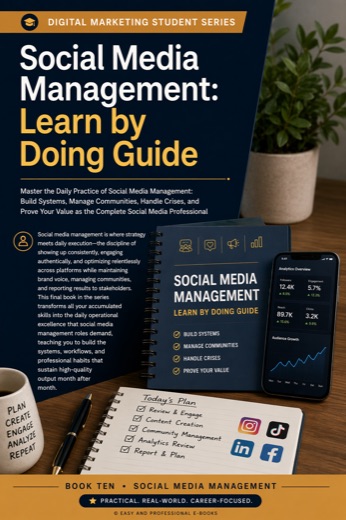
You can learn how to become a social media manager with no experience without a marketing degree, an agency job, or a single line on your resume. What hiring managers and first clients actually want is proof: evidence that you can run a real account, keep quality high week after week, handle a community, and report results in business language. The fastest way to get there is to stop waiting for permission and start managing an account yourself, documenting everything as if it were a paid engagement.
This guide breaks the path into the pieces that matter: the skills the role really demands, the tool stack you can master for free, the portfolio you build from scratch by simulating professional work, and how to convert all of it into your first role or client. Follow it and within about 90 days you can walk into an interview with tangible results instead of empty promises.
What a Social Media Manager Actually Does
From the outside the job looks like posting content and scrolling feeds. From the inside it is a demanding, multidisciplinary role that blends strategy, creative production, community psychology, crisis readiness, data analysis, and stakeholder communication, often in the same day. Understanding the four core skill areas tells you exactly what to practice:
- Strategic planning - defining audiences, choosing platforms, setting KPIs, and building content calendars aligned to real business goals.
- Content production - writing captions, designing visuals, and editing video across platforms while keeping brand voice consistent.
- Community management - responding to comments and messages with the right tone, speed, and escalation judgment.
- Analytics and reporting - tracking performance and translating it into results stakeholders understand and fund.
A typical day runs on a rhythm. Morning (roughly 8-10 a.m.): review overnight mentions and messages, respond in brand voice, and scan trends for opportunities or crisis triggers. Midday (10 a.m.-1 p.m.): a protected production block for creating and scheduling content. Afternoon (1-4 p.m.): publish, monitor early engagement, and review analytics. End of day (4-5 p.m.): a final community sweep and queue tomorrow's posts. One warning that comes with the territory: social media never sleeps, but you must. Set after-hours boundaries and use scheduling tools for presence without personal availability - sustainable managers protect their own time on purpose.
The Skills You Need to Build First (No Job Required)
You do not need experience to build skills. You need reps. Pick one account you control - a personal brand, a student club, or a small local business that will let you volunteer - and use it as your training ground. Practice each core skill deliberately:
- Brand voice consistency: write ten captions in one voice and audit whether a stranger would recognize them as a single brand.
- Content pillars: define three to five recurring themes so your calendar never drifts into random posting.
- Response fluency: draft approved replies for praise, questions, complaints, and trolls before you ever need them.
- Data reading: pull one platform's native analytics weekly and write one sentence explaining what changed and why.
Two habits accelerate everything else. First, follow the industry: give 15 minutes a day to social media publications, platform blogs, and practitioner communities so you can speak fluently about algorithm changes and emerging formats in an interview. Second, keep a personal experimentation account where you try new features and formats before recommending them - first-hand experience produces far more credible advice than repeating what you read.
Learn the Tool Stack Employers Expect
Tool fluency is a concrete, demonstrable skill you can name in an interview. Do not drown in apps - start with a three-tool core stack and add only when a real bottleneck justifies it.
| Category | Common tools | What it does for you |
|---|---|---|
| Scheduling and publishing | Buffer, Hootsuite, Later, Sprout Social | Queue a week of content in advance so you stay consistent even on busy days |
| Design and production | Canva, CapCut, Figma, Adobe | Turn branded templates into finished posts in minutes, not hours |
| Analytics and listening | Native insights, Google Analytics, Brandwatch, Mention | Track performance and catch brand mentions or issues early |
Then learn what to automate and what to keep human. Automate confidently the repetitive, rules-based work - scheduling, mention alerts, report generation. Keep human always the things that need judgment and emotional intelligence: community engagement, crisis decisions, creative concepts, and sensitive-topic calls. You can use AI to speed up ideation and first-draft captions, but your editing is what keeps the voice authentic. That balance is exactly what separates a professional from someone who blasts identical content everywhere.
How to Build a Portfolio With No Experience
This is the heart of becoming a social media manager with no experience: run a management simulation. Choose a real account, manage it for 90 days using professional systems, and document everything as though it were a client engagement. Simulated management backed by real data beats a stack of theoretical strategy slides every time. Your portfolio should contain four pieces:
- Strategy document - audience research, platform selection rationale, content pillars, and defined KPIs.
- Content calendar sample - a month of planned content with notes showing how analytics informed your choices.
- Performance case study - before-and-after metrics, the changes you made, and the results they produced.
- Sample report - one monthly report that shows you can communicate results to a stakeholder, not just create posts.
Quantified improvement is the most persuasive thing in the entire portfolio. "Grew engagement rate from 1.8% to 3.1% in eight weeks by shifting to carousels" says more than any certificate ever could. To make the case study convincing, capture a clean baseline in week one - current followers, engagement rate, reach, and posting cadence - then annotate every strategic change you make so the before-and-after tells a cause-and-effect story rather than a lucky streak. Screenshots and reports captured in real time are far stronger than numbers reconstructed months later.
The Daily Systems That Prove You Are Professional
Anyone can post once. Professionals build systems that sustain quality without heroics. Learn and demonstrate these:
- A content calendar with three layers: a monthly strategic layer (themes, key dates), a weekly tactical layer (specific posts and formats), and a daily execution layer (real-time swaps and engagement priorities).
- Template libraries: build reusable visual templates, caption structures, hashtag sets, and response templates. Good templates cut design time per post from 30 minutes to 5 while keeping everything on-brand.
- Batch creation: produce a full week of content in a few focused sessions - one for planning, one for visuals, one for copy, one for scheduling - instead of scrambling minutes before publishing.
- An evergreen content bank: keep 10 to 15 pre-approved posts ready to publish when plans change or news breaks.
- The RACE community framework: Respond within about two hours, Amplify user-generated content, Connect proactively with your community's own posts, and Elevate your most engaged members into advocates.
- The STOP crisis protocol: when something goes wrong, Stop scheduled content, Triage severity, Organize the response, then Publish and monitor. Having this ready signals real professional maturity.
Prove Your Value With Reporting
Reporting is where social media managers stop being seen as "the person who posts" and start being seen as strategic. The gap between execution roles and leadership is almost always communication skill - the ability to translate platform metrics into business language. Tailor every report to its audience using the EMTC pattern:
- Executive reports: business impact only - leads, customer acquisition cost, revenue attributed to social, sentiment trends. Executives care about outcomes, not posting frequency.
- Manager reports: performance trends, content effectiveness, and optimization recommendations detailed enough to guide resourcing.
- Team reports: content performance and upcoming plans that keep marketing functions aligned.
- Client reports: results plus strategic analysis and next-period recommendations, always tied to the client's stated goals.
Build an ROI narrative that combines direct revenue attribution, cost savings, and brand-equity contribution, and speak in numbers stakeholders already understand: "Social generated 340 qualified leads at $12 each, 60% below paid search." Before you include any metric, run the "so what?" filter - if it does not connect to a business outcome or a decision, cut it.
Land Your First Clients or Role
With a portfolio in hand, choose an entry path that fits your goals:
- Agency path: junior coordinator to manager to senior strategist. Fast skill growth through exposure to many brands.
- In-house path: coordinator to manager to head of social. Deeper strategic influence over one brand.
- Freelance path: manage social for a few small businesses. Flexible, and demand is strong for professional presence.
- Specialization: community, analytics, paid social, influencer, or crisis management. Deep expertise commands premium pay because it is rarer than generalist skill.
For a first freelance client, lead with value instead of a cold pitch: offer a free audit of a local business's social presence with three specific, prioritized fixes, then propose a one-month trial to implement them. A small, real result you can point to opens the door to the next client, and each engagement becomes another case study.
Prepare for the four interview question types: strategy ("how would you build a strategy for our brand?"), operational ("describe your content workflow"), crisis ("how would you handle a viral negative comment?"), and analytics ("how do you measure success?"). Answer each with a specific example from your simulation. Keep your own professional accounts sharp - they are a living portfolio hiring managers will check - and network inside practitioner communities on LinkedIn, Slack, or Discord, where social media hiring often happens through referrals rather than job boards.
How to Become a Social Media Manager With No Experience in 90 Days
Here is how to become a social media manager with no experience on a realistic timeline:
- Days 1-30 - Systems and foundation: pick your account, set up your three-tool stack, build your content calendar and idea pipeline, create template libraries, and start daily community management.
- Days 31-60 - Operational excellence: expand to a second platform, run a user-generated content campaign, build your reporting infrastructure, and write your first ROI-style report.
- Days 61-90 - Portfolio and readiness: assemble your performance case study, polish all four portfolio pieces, and rehearse a five-minute walkthrough of your sprint as a professional case study.
Ninety days of documented, systematic work turns "no experience" into "here is exactly what I did and what it produced."
Frequently asked questions
Do I need a marketing degree to become a social media manager?
No. A degree can help but it is not required. Employers hire on demonstrated ability - a portfolio, real results, and fluency with tools and workflows. A documented 90-day management simulation often outweighs a credential with no execution behind it.
How long does it take to get hired with no experience?
Plan on roughly three months of focused, daily practice to build a job-ready portfolio. From there, timelines vary with your market and effort, but candidates who show quantified results and rehearsed answers move much faster than those relying on theory.
Which platform should I learn first?
Start where your target audience already spends time, and manage one platform excellently before adding a second. Two platforms managed well beats five managed poorly, and depth on one channel is easier to turn into a convincing case study.
How do I get results without a real client or budget?
Volunteer to manage a student org, a personal brand, or a small local business. Real accounts with real (even small) audiences give you genuine data, and that documented data is what proves your capability to an employer.
This article is a starting point. The complete guide walks you through the full daily practice of professional social media management - the content systems, community frameworks, crisis protocols, reporting templates, and the step-by-step 90-day sprint that turns a beginner into a portfolio-ready professional.