If you end most workdays exhausted but unsure what you actually moved forward, you don't have a time problem — you have a priority problem. Almost everyone who feels "buried at work" is actually drowning in tasks that feel urgent but change very little. The good news is that prioritization is a learnable skill, not a personality trait. This guide gives you a complete, ready-to-use system — the famous Eisenhower Matrix — plus the vocabulary, real examples, common mistakes, and daily habits you need to put it into practice today. By the end, you'll be able to look at any chaotic to-do list and know exactly what to do first, what to schedule, what to hand off, and what to delete.
The real reason your to-do list feels impossible
Most productivity advice assumes you simply need more hours or a better app. In reality, the trap is psychological. When everything lands in your inbox with the same red exclamation mark, your brain treats all of it as equally important — and that triggers decision fatigue.
Decision fatigue (pronunciación adaptada al español: di-SÍ-shon fa-TÍG) is the mental exhaustion that comes from making too many decisions in a row. Each tiny choice — "Do I answer this email now? Do I jump into this thread? Do I take this call?" — drains the same limited tank of willpower. By 3 p.m., you're not lazy; you're depleted. That's why you start doing easy, low-value tasks just to feel productive, while the work that actually matters keeps slipping.
The escape is to make the sorting decision once, with a clear rule, instead of re-deciding all day. That rule is the difference between urgency and importance.
Urgency vs. Importance: the distinction that changes everything
Urgency vs. Importance (UR-yen-si vs. im-PÓR-tans) is the foundation of the whole system, so it's worth slowing down here.
- Urgency asks: "What is the real deadline, and what is the actual cost of a 24-hour delay?" It measures time pressure.
- Importance asks: "How much does this change my goals, my results, or my future workload?" It measures real impact.
The reason work feels overwhelming is that urgent things announce themselves — a ringing phone, a Slack ping, a "URGENT" subject line — while important things sit quietly and wait. A pinging notification feels more pressing than writing the strategy that will define your next quarter, even though the strategy matters a hundred times more.
Concrete example: A coworker messages "Can you send me that file real quick?" That feels urgent. But if the cost of a one-day delay is essentially zero, it is not urgent — it just feels urgent because someone is waiting. Meanwhile, preparing for tomorrow's client presentation is genuinely important and quietly becoming urgent, yet it makes no noise at all. Train yourself to ask the urgency question literally out loud: "If I don't do this today, what actually breaks?"
The Eisenhower Matrix, explained in full
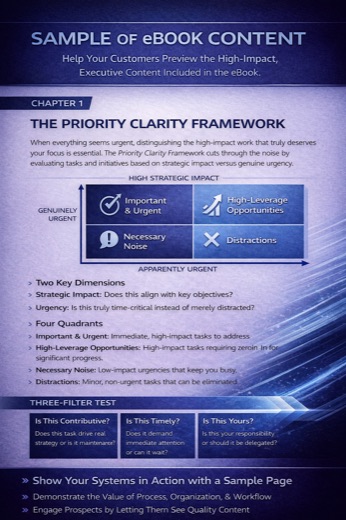
The Eisenhower Matrix is a two-dimensional framework attributed to U.S. President Dwight D. Eisenhower, who reportedly said, "What is important is seldom urgent, and what is urgent is seldom important." It crosses two questions — Is it important? and Is it urgent? — to create four quadrants. Every single task you have fits into exactly one of them.
Quadrant 1 — Important + Urgent: do it now, personally
These are crises and hard deadlines: the client deliverable due at 5 p.m., the production bug taking down your app, the proposal that must go out tonight. The rule is simple — do it now, personally. You don't delegate these and you don't schedule them for "later," because later doesn't exist.
The catch: if you live only in Quadrant 1, you're in constant firefighting mode. A healthy professional spends as little time here as possible — and the way you shrink Quadrant 1 is by taking Quadrant 2 seriously.
Quadrant 2 — Important + Not Urgent: protect and schedule it
This is where careers are built: planning, learning a new skill, building relationships, deep strategic work, preventive maintenance, exercise, and rest. Nothing forces you to do these today, which is exactly why they get crushed by noise. The rule here is to protect the time — put it on your calendar as a real appointment, not a vague intention.
This is where deep-work time lives — protected, distraction-free blocks for the high-impact work that requires real concentration. And it's where you do your high-leverage work: the tasks that produce maximum impact relative to the time you invest. One hour writing a reusable template can save you twenty hours later — that's leverage. Answering the same question by hand for the tenth time is not.
Quadrant 3 — Urgent + Not Important: delegate it
This is the most dangerous quadrant because it masquerades as real work. Many meetings, most "quick" interruptions, and a large share of email belong here. They're urgent to someone, but they don't move your important goals. The rule is to delegate what you can, automate what you can't delegate, and ruthlessly trim the rest. If you can't hand it off, can you template it, batch it, or set an autoresponse?
Quadrant 4 — Not Important + Not Urgent: eliminate or defer
Busywork, doom-scrolling, low-value status updates, the report nobody reads. The rule: eliminate or defer. Deleting a task is a legitimate, often superior outcome. Every task you remove is a decision you'll never have to make again.
The quick filter for a chaotic morning
When you don't have time to draw a matrix, use the one-line quick filter:
"If I don't do this today, what actually breaks?"
- If something genuinely breaks (a deadline is missed, a customer is harmed, money is lost) → it's Quadrant 1, do it now.
- If nothing breaks but it matters for your future → it's Quadrant 2, schedule it.
- If it only breaks for someone else and it's not yours to own → Quadrant 3, delegate or push back.
- If nothing breaks at all → Quadrant 4, drop it.
This single question cuts through the false urgency that drives decision fatigue. Say it out loud a few times a day and you'll be shocked how much "urgent" work quietly evaporates.
A real-world walkthrough
Imagine your Monday list: (1) a budget proposal due Wednesday, (2) 14 unread emails, (3) a teammate asking you to review a slide deck "whenever," (4) learning the new analytics tool your team adopted, (5) a 30-minute "sync" meeting with no agenda, and (6) scrolling industry news.
- Budget proposal (Q1 soon): important and becoming urgent. Block deep-work time this morning before it turns into a crisis.
- 14 emails (mostly Q3): batch them into two fixed slots, not a constant trickle. Most are urgent-feeling, not important.
- Slide-deck review (Q3): "whenever" means not urgent. Delegate a first pass or schedule 15 minutes; don't drop your proposal for it.
- Learning the analytics tool (Q2): pure high-leverage work. Schedule a recurring 45-minute block this week.
- Agenda-less sync (Q3/Q4): ask for an agenda or decline. A meeting with no agenda is rarely important.
- Industry scrolling (Q4): eliminate, or cap it at 10 minutes during a break.
Notice that only one task truly demanded your morning. That's almost always the case.
Common mistakes (especially if English is your second language)
- Reading "ASAP" and "urgent" literally. In English-speaking workplaces, "ASAP" (as soon as possible) and even "URGENT" are often social pressure, not real deadlines. Politely ask: "What's the actual deadline on this?" Native speakers do this constantly; it is not rude.
- Confusing "important" with "important to my boss right now." A task can be urgent for someone else and still belong in your delegate or defer pile. Importance is measured against your goals and responsibilities.
- Treating "let's circle back" or "let's touch base" as commitments. These idioms ("circle back" = retomar el tema más tarde; "touch base" = ponerse en contacto brevemente) usually mean "later, maybe." Don't let them jump your queue.
- Saying yes to avoid seeming difficult. Over-agreeing fills your day with Quadrant 3 work. A calm "I can get to that on Thursday — does that work?" is professional, not aggressive.
- Spending all day in Quadrant 1. If every day is firefighting, you're not prioritizing — you're reacting. Protect Quadrant 2 time to shrink tomorrow's fires.
Practical habits that make it stick
- Choose your "big three" the night before. Decide tomorrow's three most important tasks today, while your mind is clear. You'll skip the morning decision fatigue entirely.
- Calendar-block Quadrant 2. If it isn't on the calendar, it won't happen. Treat deep-work time like a meeting you can't move.
- Batch the noise. Check email and chat at set times (for example, 11 a.m. and 4 p.m.) instead of continuously. This kills false urgency at the source.
- Build a "delete" habit. Once a week, scan your list and remove anything in Quadrant 4. Finishing is good; deleting is sometimes better.
- Make a "not-doing" list. Writing down what you've consciously decided not to do removes the guilt and the mental loop.
- Review weekly. Fifteen minutes every Friday to re-sort tasks keeps the matrix honest and stops your list from quietly refilling with low-value work.
Putting it all together
Prioritizing at work is not about doing more — it's about deciding, once and clearly, what deserves your attention. Use the Eisenhower Matrix to sort every task by importance and urgency. Do Quadrant 1 now, protect Quadrant 2 fiercely, delegate Quadrant 3, and delete Quadrant 4. When in doubt, fall back on the quick filter: "If I don't do this today, what actually breaks?" Do that consistently and you'll spend your days on high-leverage work instead of someone else's emergencies.
If you'd like ready-made rituals, polite scripts for saying no, and printable planning templates to make this a daily habit, Asher Editions publishes practical productivity and professional-English guides that build on exactly these ideas.
Frequently asked questions
What is the difference between urgent and important tasks?
Urgent tasks have a real deadline and a real cost if delayed — the question is "what's the cost of a 24-hour delay?" Important tasks change your goals, results, or future workload, regardless of any deadline. Many urgent tasks are not important (a "quick" favor for someone else), and many important tasks are not yet urgent (planning, learning). Sorting on both dimensions at once is the whole point of the Eisenhower Matrix.
How do I prioritize when everything feels urgent?
Use the quick filter — ask out loud, "If I don't do this today, what actually breaks?" If nothing genuinely breaks, the task isn't truly urgent; it just feels that way because someone is waiting or a notification is blinking. Then place each task in one of the four quadrants and act on its rule: do, schedule, delegate, or delete.
What is the Eisenhower Matrix in simple terms?
It's a four-box grid that sorts tasks by two yes/no questions: Is it important? Is it urgent? The four boxes are: Important + Urgent (do now), Important + Not Urgent (schedule), Urgent + Not Important (delegate), and Not Important + Not Urgent (eliminate). It turns a messy list into four clear actions.
How can I prioritize tasks if I'm not in charge of my own schedule?
You still control how you respond. When work is assigned with vague urgency, ask for the real deadline ("What's the actual due date?"). Batch interruptions into set times, propose realistic timelines instead of agreeing instantly, and protect at least one small block of deep-work time each day. Even a little Quadrant 2 time reduces the crises that consume the rest of your week.
Is it really okay to delete tasks instead of doing them?
Yes — deleting low-value tasks (Quadrant 4) is often the best decision you can make. Every task you remove is a decision you never have to make again, which directly reduces decision fatigue. Keeping a short "not-doing" list of things you've consciously dropped removes the lingering guilt and frees mental space for high-leverage work.
How do I say no without sounding rude or unprofessional?
Offer a realistic alternative instead of a flat refusal. Phrases like "I can get to that Thursday — does that work?" or "Happy to help; what's the real deadline?" are completely normal in English-speaking workplaces. Asking for a deadline or proposing a timeline signals reliability, not resistance. Native professionals push back this way constantly.
How is the Eisenhower Matrix different from a simple to-do list?
A to-do list tells you what to do; the matrix tells you in what order and how to handle each item. A flat list treats every task as equal, which feeds decision fatigue. The matrix forces two quick judgments — importance and urgency — so you immediately know whether to do, schedule, delegate, or delete, instead of just working top to bottom.